Honeybush is not one plant. It is twenty-three, and the difference between them is the difference between a good blend and an anonymous one.
Most honeybush sold in North America arrives with no species named on it. It is bought as "honeybush," blended as "honeybush," and sold as "honeybush."
That is a bit like selling wine labelled "grape."
The genus is Cyclopia. There are twenty-three species in it. Six are harvested commercially, and they do not taste the same — some are deep and almost woody, others floral and light. Which ones go into a blend, and in what proportion, is the single biggest decision in sourcing honeybush.
The species that matter
Cyclopia intermedia — bergtee, "mountain tea"
The deep one. It grows wild high in the Cape Fold mountains, and it accounts for the large majority of the wild-harvested crop.
Robust, dark, honeyed, with a resinous edge the others do not have. It gives a blend its bottom end — the part that stays in the mouth after the floral notes have gone.
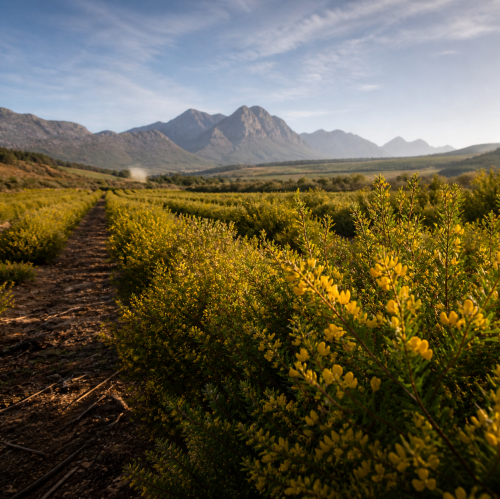
It is also the difficult one. C. intermedia resists cultivation. It propagates poorly from cuttings, and despite years of agricultural research the commercial supply still comes largely off wild mountain stands, harvested by hand on a multi-year rotation. Availability moves with the season and the rainfall in a way farmed material does not.
Cyclopia subternata — vleitee, "marsh tea"
The floral one. It grows in wetter ground — valley bottoms and seeps — and unlike intermedia it takes to cultivation well, which is why it now makes up a large share of the farmed crop.
Lighter, sweeter, more perfumed. Apricot and blossom rather than resin and depth. On its own it can read as thin; alongside intermedia it lifts the whole cup.
Cyclopia longifolia
Grown along the southern coastal belt. Gentle, clean, honeyed without much weight behind it — a rounding species rather than a leading one. It fills the gap between the depth of intermedia and the top notes of subternata, and a blend without something in that role tastes hollow in the middle.
Cyclopia genistoides — kustee, "coastal tea"
The coastal species, from the sandy plains near the sea. Sweet and bright. Cultivated commercially, though less common in export blends.
Cyclopia maculata and Cyclopia sessiliflora
Harvested in smaller quantities, mostly regionally.
What Shanti Tea uses
Two specifications, imported directly from the Cape.
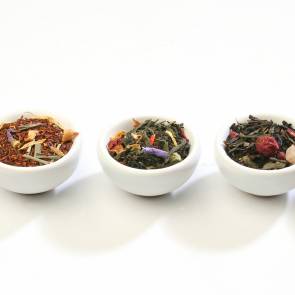
The floral blend — 50% C. subternata / 50% C. longifolia. No intermedia. Lighter, more perfumed, cleaner. This is honeybush at its most delicate, and it is the one that works as a straight cup.
The full blend — C. intermedia, C. subternata and C. longifolia. Mountain depth underneath, floral lift on top, the coastal species holding the middle. Rounder and more substantial than the floral blend, and it is what stands up when other ingredients are added.
The full blend is the base of Apple Crumble, at 30% intermedia, 30% subternata, 40% longifolia. Baked apple and cinnamon need something with body under them or they sit on nothing. The intermedia provides that. The longifolia keeps it from going heavy because a straight intermedia base would swallow the apple entirely. The proportions were arrived at by tasting, not by theory. Similarily, the full blend is a base of our Banana Bread and Apple Chai for most delicious sweet flavor and aroma.
Fermented and green
Honeybush is normally oxidised after cutting. It os chopped, held in tanks at high temperature, then dried. The industry calls it fermentation, though nothing ferments. It is what turns the leaf dark and brings out the honey.
Green honeybush skips it. The result is paler, lighter, grassier and keeps more of the floral character without the depth.
A note on sustainability
Every commercially harvested Cyclopia species appears on the IUCN Red List. The wild resource is finite, the plants grow slowly and demand has risen faster than the mountains can supply.
The industry has been shifting toward cultivation in response, and more than half of production now comes from farmed land rather than wild stands, a reversal of where things stood fifteen years ago. Wild harvesting continues under government guidelines that set rotation periods and offtake limits, and it remains an important source of income in the rural Langkloof.
Buying honeybush by named species is part of that picture. It means knowing whether the material came off a farm or a mountain and it makes the supply chain legible in a way that anonymous bulk buying does not.
Brewing
Boiling water. Five to seven minutes, or longer — honeybush is low in tannin and will not turn bitter. A heaped teaspoon per cup, generously, since the leaf is bulky.
For iced, cold brew rather than brewing hot and chilling. Eight to twelve hours in the fridge. The honey note survives cold brewing and largely does not survive being cooled down after a hot steep.
At Shanti Tea we use certified organic honeybush, imported directly from a long-standing grower in the Southern Cape and used by species in every blend.
Blended and packed in small batches in Ottawa.