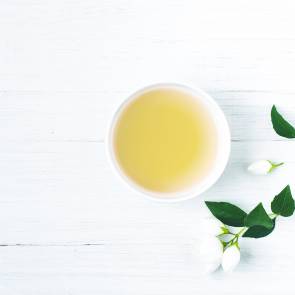
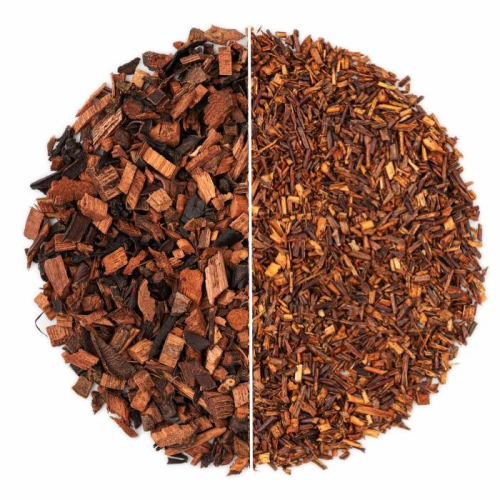
Two caffeine-free teas from the same corner of South Africa. Same landscape, different plants and they taste nothing alike.
Rooibos is familiar. It has been on Canadian shelves for thirty years and most people have had a cup whether they went looking for one or not.
Honeybush is the one that gets mistaken for it. Same country, same reddish liquor, same caffeine-free promise. Shops often shelve them together and leave it at that.
They are not the same tea. They are not even the same plant genus. And once tasted side by side, nobody confuses them again.
First, a word about fynbos
Both plants come from fynbos — a shrubland that covers the southwestern tip of South Africa and exists nowhere else on earth.
The name is Afrikaans, roughly "fine bush," after the narrow needle-like leaves most of the plants share. It looks unremarkable from a distance. Low, grey-green, scrubby. Up close it is one of the densest concentrations of plant life on the planet: around 9,000 species packed into an area smaller than New Brunswick and roughly seven in ten of them grow nowhere else.
Fynbos also burns. It has to. Many of the plants will not release seed or send up new growth until fire has passed through and a stand that has burned recently produces better material than one that has not. Harvesters know this and work with it.
This matters for one reason above all: neither honeybush nor rooibos has ever been successfully grown anywhere else. Coffee moved to Brazil. Tea moved to Kenya. Both of these plants stayed put, despite considerable effort to move them. What grows in fynbos stays in fynbos.
Different plants entirely
Rooibos is a single species — Aspalathus linearis. One plant, one growing region: the Cederberg mountains, at the dry northern edge of fynbos, a few hours north of Cape Town. Hot summers, cold nights, poor sandy soil. It is farmed at scale, has been for decades, and the supply is consistent.
Honeybush is a genus — Cyclopia — with twenty-three species in it. Six are harvested commercially. They grow further south and east, through the Cape Fold mountains and down onto the coastal plains, where there is more rain and more mist.
How they taste
Rooibos is woody and full, with a vanilla sweetness underneath and a faint smokiness from the oxidation. It has weight. It coats the mouth. The colour is deep brick-red and it takes milk without falling apart.
Honeybush is rounder and softer. The dominant note is honey — the plant is named for the scent of its flowers and it carries through into the cup with dried apricot and a floral lift behind it. Less wood, less structure but more perfume.
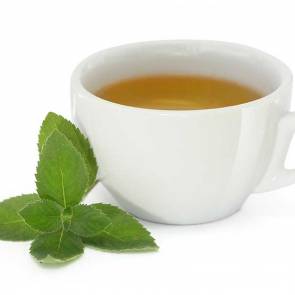
Held side by side in clear glass, the difference is obvious before the first sip. Rooibos is opaque and red. Honeybush is amber and clearer.
Neither turns bitter, both are naturally low in tannin, which means a forgotten pot is still drinkable - a genuinely useful property that ordinary tea does not have.
The green versions
Both plants are normally oxidised after harvest, in tanks, and at high temperature. This is what develops the red colour and the deeper flavour. The industry calls it fermentation, though nothing actually ferments.
Without the fermentation, the tea simply stays green.
Green rooibos is pale gold, grassy, with a clean hay-and-melon character. Lighter than the red. It suits iced brewing particularly well.
Green honeybush is rarer, lighter still and keeps more of the floral top note without the honeyed depth.
How they behave in a blend
Rooibos is a workhorse base. It holds flavour without competing, which is why it turns up under so much vanilla, chai and berry. It will carry almost anything.
Honeybush is less neutral. The honey-and-stone-fruit character is a voice in the blend and it wants ingredients that agree with it like apple, apricot, cinnamon, vanilla, warm baking spices.
Brewing
The method is the same and it is forgiving.
Boiling water, fully boiling. Five to seven minutes and longer if wanted because neither will turn bitter. Roughly a heaped teaspoon per cup, can use more for honeybush, which is a bulkier leaf.
For iced, cold brew rather than brewing hot and chilling. Eight to twelve hours in the fridge, then strain. Cold brewing keeps the honey note on honeybush and the sweetness on rooibos, both of which flatten out when a hot brew is cooled down.
Which one to choose
For a caffeine-free everyday cup that behaves like a strong black tea and takes milk — rooibos.
For something with more perfume and more sweetness, closer to a dessert tea, drunk plain — honeybush.
For a caffeine-free tea nobody at the table has had before — honeybush, easily.
At Shanti Tea
Both, rooibos and honeybush, are certified organic and imported directly from South Africa, and the honeybush is specified down to the species: the exact Cyclopia proportions are chosen for each blend rather than bought as an anonymous commodity.
Blended and packed in small batches in Ottawa.